





Key Takeaways
- Mechanical dewatering reduces sludge volume and disposal costs.
- Match equipment to the material and project requirements.
- Sandling provides mobile dewatering, rentals, repairs, and maintenance.
- Renting is ideal for temporary or emergency projects.
- Complete project details help ensure the right solution.
Excess water can turn a manageable sludge or slurry project into a costly operational problem. Higher liquid content means more material to store, haul, process, and dispose of. For municipalities, wastewater treatment facilities, and industrial contractors, mechanical dewatering services can provide a practical path to reducing volume and preparing solids for the next stage of handling.
Sandling Industrial Services supports projects that require mobile dewatering equipment, filtration systems, equipment rentals, maintenance, repairs, and field-oriented support. Rather than treating every job as an equipment-only transaction, the company can help evaluate the waste stream, site conditions, schedule, and desired outcome before identifying a practical approach.
Why Do Wastewater Projects Need Mechanical Dewatering?
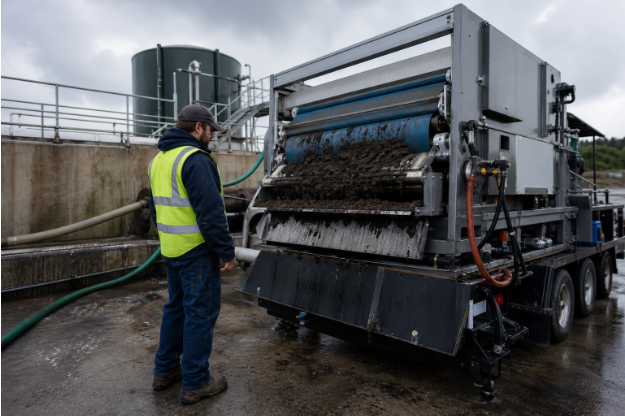
Mechanical dewatering separates liquid from sludge, slurry, or wastewater residuals to create a more manageable solid material, commonly called cake. Reducing water content may lower hauling volume, simplify on-site storage, improve transfer options, and support disposal or beneficial-use planning.
Different waste streams respond differently to dewatering. Municipal biosolids, industrial wastewater solids, dredged sediment, and produced waste can vary significantly in particle size, chemical composition, feed solids concentration, and consistency.
Results depend on more than a machine’s nameplate capacity. Feed consistency, polymer conditioning, belt speed, wash-water availability, operator adjustments, and the project’s throughput goals all influence dewatering performance. That is why selecting a provider with both equipment options and practical service experience matters.
How Sandling Industrial Services Matches Equipment to the Waste Stream
A useful mechanical dewatering plan starts with details. Sandling Industrial Services can review the application before mobilization so the system aligns with the job rather than forcing the job to fit a single equipment type.
- Identify the material. Determine whether the project involves municipal sludge, industrial wastewater, lagoon solids, dredged material, produced waste, or another solids-rich stream.
- Review operating conditions. Consider the estimated flow, feed solids percentage, available footprint, site access, power, water, drainage, staffing, and discharge requirements.
- Compare suitable equipment. A belt press, plate-and-frame press, sand filter, dredge, or related system may be appropriate, depending on the material and performance target.
- Plan delivery and setup. Mobile projects require attention to transportation, staging, connections, operating support, maintenance access, and safe site movement.
- Establish measurable goals. Define expectations for throughput, solids capture, cake consistency, labor needs, and disposal readiness.
Mechanical Dewatering Equipment and Support Options
Sandling Industrial Services offers equipment and services to support temporary capacity needs, planned maintenance periods, and project-specific solids-handling needs. Available options may include the following:
- 1.7-meter belt presses: Mobile dewatering capacity for municipal and industrial sludge applications.
- 2-meter belt presses: A larger belt-width option for projects with greater processing requirements.
- Plate and frame presses: Recessed-chamber filtration equipment for batch-oriented applications and higher-solids cake production.
- Sand filter rentals: Temporary filtration support when water quality or treatment demands require an additional layer of solids removal.
- Mini dredges and workboat equipment: Options for ponds, lagoons, sediment, skimming, cutting, and shallow-water material recovery.
- Repair and maintenance services: Technical support for water-treatment and dewatering equipment when reliability or downtime is a concern.
When Is Renting Better Than Buying?
Rental equipment can be a strong fit when a facility needs short-term capacity but does not need to own and maintain a permanent system. It may also help contractors respond to a project with a limited duration, uncertain schedule, or changing site conditions.
- A permanent unit is offline for maintenance or repair.
- Seasonal demand creates a temporary increase in sludge volume.
- A contractor needs mobile equipment at one or more job sites.
- Capital investment is difficult to justify for an infrequent need.
- The facility wants to assess operating performance before committing to ownership.
Renting is not automatically the right answer. Project duration, expected utilization, transport costs, staffing, storage, maintenance responsibility, and long-term processing needs should all be compared before making a decision.
Improving a Belt Press Dewatering Plan
Equipment selection is only the beginning. Effective belt press operation often requires close attention to polymer preparation and dosage, feed consistency, belt speed, drainage conditions, wash-water flow, and routine maintenance. Small operating changes can affect cake solids, filtrate quality, and production rates.
Sandling Industrial Services can support a more reliable plan by pairing equipment knowledge with maintenance, troubleshooting, and site-specific operating considerations. If the material changes, the dewatering approach may need to change with it.
What to Include in a Mechanical Dewatering Services Request
Complete information helps a provider assess the project faster and recommend a more suitable system. A request should include:
- Company, facility, and project name
- Project location, access limitations, and site-contact details
- Waste stream source and material description
- Estimated daily volume, flow rate, and approximate feed-solids percentage
- Required start date, operating schedule, and expected project duration
- Available power, water, drainage, space, and staging area
- Desired cake condition, solids-capture goal, or disposal requirement
- Existing equipment, known performance issues, and maintenance concerns
- Whether transport, setup, operators, repairs, or ongoing service are needed
Why Choose Sandling Industrial Services?
Sandling Industrial Services is positioned to support wastewater plants, municipalities, and industrial contractors with mobile equipment, dewatering and filtration capabilities, repair services, and maintenance support for projects across the United States. Mobile systems can be particularly valuable when building permanent dewatering capacity is not practical.
Before selecting any provider, compare equipment range, mobility, technical support, project-fit evaluation, and ability to respond to changing field conditions. A detailed request provides Sandling Industrial Services with the information needed to determine whether a belt press, plate-and-frame press, filtration system, dredging solution, or related service is the right fit.
Conclusion
A well-prepared mechanical dewatering services request can reduce delays and improve the likelihood of selecting equipment that fits the material, site, and schedule. With mobile dewatering equipment, filtration options, maintenance, repairs, and nationwide project support, Sandling Industrial Services offers a practical resource for organizations managing sludge, wastewater residuals, and other solids-handling challenges.




+ There are no comments
Add yours